
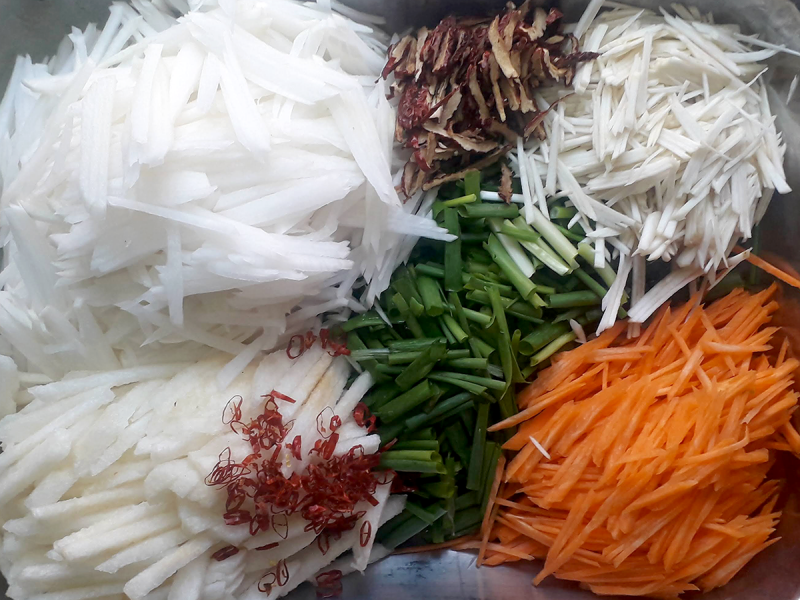
Essential string-cut knife technique used for all supplementary aromatic and structural vegetables in Kimchi making. By finely cutting Asian radish (Mu), carrots, pears, and scallions into uniform matchsticks, the surface area expands significantly. This allows the fresh vegetable strands to easily fold into and bind with the viscous spice paste (Kimchi-so), ensuring an even distribution of moisture, sweetness, and crunch between every leaf layer of the cabbage.
The Art of Chae (채) : String Cut Mechanics
How traditional Korean Julienne cutting transforms hard aromatics and fruits into cohesive binding elements for Kimchi-so (양념).
Purpose of Chae (채썰기) in Kimchi Making
MECHANIC 01
Paste Integration
Thin matchstick strands interlock naturally with glutinous rice glue, binding Gochugaru and aromatics into a smooth, cohesive paste.
MECHANIC 02
Rapid Osmotic Release
Exposing more cellular wall surface allows salt and fish sauce (Jeotgal) to quickly draw out natural sugars and fruit juices.
DIMENSIONMECHANIC 03
Inter-Leaf Tucking
Flexible vegetable ribbons slide effortlessly between tight cabbage leaves without clumping or falling out into the brine.
Chae Technique Applied by Ingredient
Asian Radish (무) & Carrot (당근)
Sliced first into diagonal planks (편썰기), then stacked and cut into uniform string strands. Radish provides the structural backbone and crunch of Kimchi-so, while carrots add vivid color and natural beta-carotene.
Target Dimension
~2mm × 2mm × 5cm matchsticks.
Korean Pear (배) & Fruit Additions
Julienned matchsticks of firm Korean pear release fresh fructose to fuel early-stage lactic acid bacteria. Cutting fruit into strings gives a subtle, refreshing bite without turning into liquid puree.
Craft Note
Cut fruit last and add directly to paste to prevent enzymatic browning.
Vegetable Cutting & Function Matrix
| Ingredient | Korean Term | Cut Style | Culinary Role in Kimchi-so |
| Korean Radish | Mu (무) | Mu-chae (무채) / Standard Julienne | Absorbs red pepper spice, adds crisp texture and volume |
| Carrot | Danggeun (당근) | Fine Julienne | Visual color contrast and earthy background sweetness |
| Korean Pear | Bae (배) | Medium String Cut | Natural sugar source; softens fish sauce pungency |
| Scallion & Green Onion | Pa / Jjopa (파 / 쪽파) | 4–5cm Length Sections | Matches string length of radish chae for balanced bite |
Extra Practices
Foundational techniques
- Slicing: Use a rocking, tip-to-heel motion to cleanly cut through an ingredient. Your non-dominant hand should form a “claw” with your knuckles guiding the blade.
- Dicing: Create uniform cubes by first creating a batonnet (a thick stick) and then cutting that into a dice of your desired size (e.g., small, medium, or large).
- Mincing: Finely chop ingredients like herbs or garlic by holding the knife’s tip down with one hand and rocking the heel up and down over the food with the other.
- Chiffonade: This is a technique for creating thin ribbons from leafy greens or herbs by stacking and rolling them, then slicing them thinly.
Safety and proper form
- Claw grip: Hold the food with your non-dominant hand in a “claw” position, with your fingertips tucked behind your knuckles. This allows your knuckles to act as a guide for the blade.
- Knuckle guide: Ensure your knife glides against your knuckles without ever lifting over the top of them to avoid injury.
- Sharp knives: A sharp knife is a safer knife. Learn proper knife maintenance to keep your blades in good condition.
- Posture: Maintain proper posture with a stable stance while cutting.
How to practice and improve
- Start slow: Focus on the technique and precision before trying to increase speed.
- Practice consistently: Practice with different vegetables to build confidence and skill.
- Focus on consistency: Work on achieving uniform size and shape in your cuts.
- Learn the cuts: Familiarize yourself with the names and purposes of different cuts, such as the batonnet, brunoise, and julienne.
- Use a stable surface: Use a good cutting board that doesn’t move.
