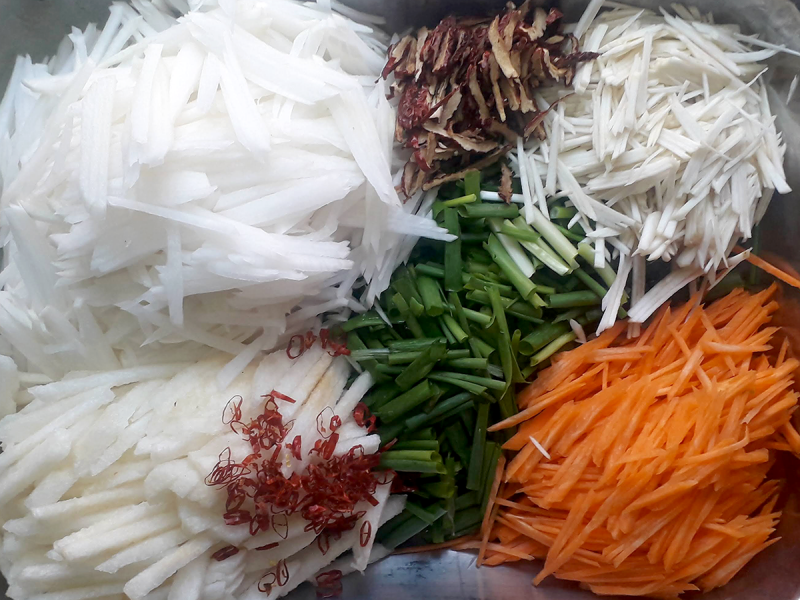
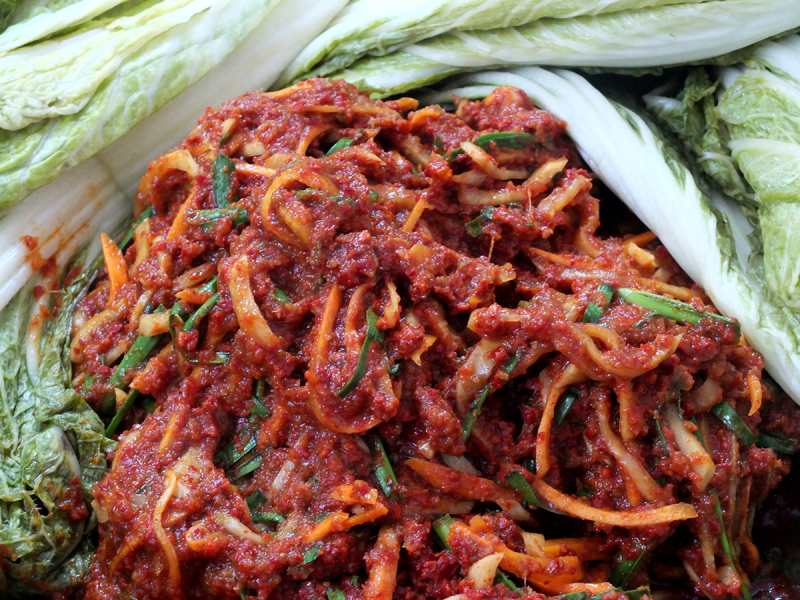
Essential aromatic paste that defines the signature depth, spice, and umami of traditional Korean Kimchi. Built on a viscous base of cooked glutinous rice porridge (Glutinous Rice Glue), this rich mixture binds vibrant Gochugaru (Korean red pepper flakes), crushed garlic, minced ginger, and Saeujeot (salted fermented shrimp) or Aekjeot (anchovy fish sauce). Mixed with fresh julienned radish, Asian chives, and green onions, Kimchi-so delivers a harmonious balance of sweet, salty, pungent, and savory notes while providing crucial complex carbohydrates that feed lactic acid bacteria during fermentation.
Traditional Composition of Spices & Flavors
The core aromatic seasoning matrix—combining microbial starches, heat, umami, and fresh aromatics to coat salted leaves for fermentation.
Functional Ingredient Pillars
PILLAR 01 · BINDER
Glutinous Rice Porridge
Acts as a natural adhesive so spices stick to leaves, while providing simple sugars to feed Lactic Acid Bacteria (LAB).
PILLAR 02 · SPICE
Gochugaru (Red Pepper)
Provides vibrant crimson color, mild-to-medium heat, and natural antioxidants (capsaicin) that inhibit food spoilage organisms.
PILLAR 03 · UMAMI
Jeotgal (Fermented Seafood)
Salted shrimp (Saeujeot) or anchovy sauce (Aekjeot) deliver amino acids and savory depth that accelerate microbial activity.
PILLAR 04 · AROMATICS
Garlic, Ginger & Greens
Crushed garlic, minced ginger, scallions, and julienned radish infuse crisp texture, essential oils, and antimicrobial properties.
Preparation Sequence
Phase A
Porridge & Gochugaru Blooming
Glutinous rice flour is simmered in water (or kelp broth) until thick, then cooled completely. Gochugaru is stirred in and left to rest, allowing the chili flakes to hydrate, bloom, and deepen in color.
Key Objective
Unlocks smooth spice dispersion and prevents raw pepper powderiness in the final product.
Phase B
Aromatic & Vegetable Binding
Finely ground garlic, ginger, and Jeotgal are folded into the chili-porridge paste. Finally, julienned radish, Asian chives (Bucheu), and scallions are gently tossed in to retain their fresh crunch.
Key Objective
Uniform distribution ensures every salted cabbage leaf receives an equal layer of fermentation seasoning.
Component & Flavor Matrix
| Ingredient | Korean Term | Flavor Contribution | Biological & Culinary Role |
| Korean Red Pepper Flakes | Gochugaru (고춧가루) | Smoky heat, mild sweetness | Provides red color; natural capsaicin acts as a biological preservative |
| Glutinous Rice Glue | Chapssal-pul (찹쌀풀) | Neutral, subtle sweetness | Thickening agent; primary carbohydrate substrate for lactic acid bacteria |
| Garlic & Ginger | Maneul & Saenggang (마늘, 생강) | Pungent, sharp, warm notes | Allicin in garlic and gingerols in ginger suppress bad bacteria strains |
| Julienned Korean Radish | Mu-sae (무채) | Crisp, refreshing, peppery | Adds physical volume between cabbage leaves and releases natural juices |
| Fish Sauce / Fermented Shrimp | Aekjeot / Saeujeot (액젓, 새우젓) | Deep umami, savory saltiness | Supplies essential amino acids that accelerate complex fermentation flavors |